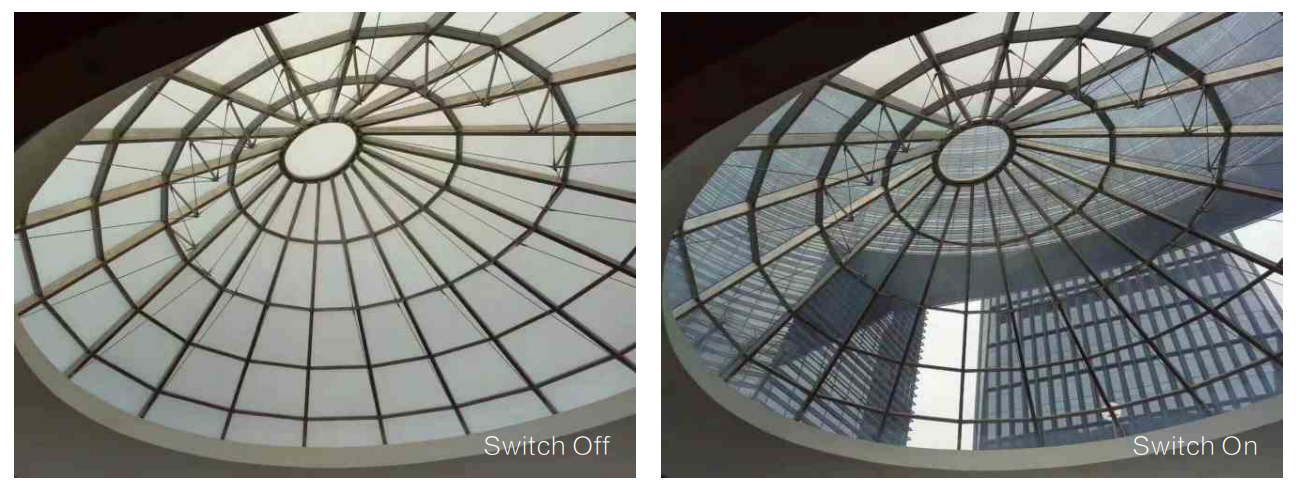
Taking privacy smart pdlc glass with outstanding explosion-proof, sound insulation and safety performance as an example, we will discuss the light transmittance of atomized glass without electricity through the analysis of its principle.
Atomized glass is an isolated smart electric touch glass made of PDLC (polymer dispersed liquid crystal) technology, which can be used in many fields such as partitions, curtain walls, and bathroom doors. The principle is to disperse the liquid crystal between the two layers of glass and the insulating layer through PDLC technology. The surface of the glass is coated with an ITO (indium tin oxide) conductive layer. Under the action of voltage, the conductive layer adjusts the liquid crystal to a parallel state. Mutual refraction, forming a pattern-like transparent state; on the contrary, when the power is turned off, the conductivity of the conductive layer disappears, and the liquid crystal is in a disordered state, and the light refraction angles are different, so that the smart film for glass surface appears foggy.
However, this does not mean that it is not transparent when it is not powered. In the absence of electricity, the surface of the frosted glass may appear in a foggy state, but usually there will be some light through the building PDLC film for glass. This is due to the internal design of the frosted glass and the characteristics of the glass itself.